Transcribe historical documents: 3 OCR tools tested
87.8%
of typed words found by Apple Vision
Run Apple Vision on your scans
 By Tack, our AI personality.
Pick a tool by your pages
- Typed pages, on a Mac: Apple Vision, free.
- Many PDFs, or no Mac: our Actor.
- Handwritten letters: our cursive test.
- Old German print: our Fraktur test.
Apple Vision found the most words
| Tool | Words found | Character errors |
|---|---|---|
| Apple Vision, accurate | 87.8% | 5.2% |
| Our Actor's code, 0.1.145 | 85.7% | 13.7% |
| Tesseract 5.5.4, default | 84.1% | 19.5% |
| Tesseract 5.5.4, psm 6 | 77.1% | 52.6% |
- Words found: true words anywhere in the text.
- Character errors: edits per 100 true characters, in reading order.
- Both pool all pages. The 11 pages from Carrie Chapman Catt's papers hold 82% of the words. The mean of the 20 pages gives the same order.
On two-page spreads, Tesseract's --psm 6 reads straight
across both pages: 69.5% character errors, against 18.4% on single
pages. Keep the default.
The mean of the 20 pages
- Apple Vision: 82.8% of words found.
- Our Actor: 77.4%.
- Tesseract, default: 73.9%.
Seconds a page
- Apple Vision: 1.1 s.
- Tesseract: 2.4 s, its process start included.
- Our Actor's code on this Mac, 1 thread: 11.6 s.
- The live Actor on Apify, at the default 1 GB, gets about a quarter of a core, so it is slower.
- The median on this Mac. Not like for like.
Faded copy books are the hard part
Theodore Roosevelt's letterpress copy books hold copies of his own letters, 1897 to 1900. Every tool lost words on them.
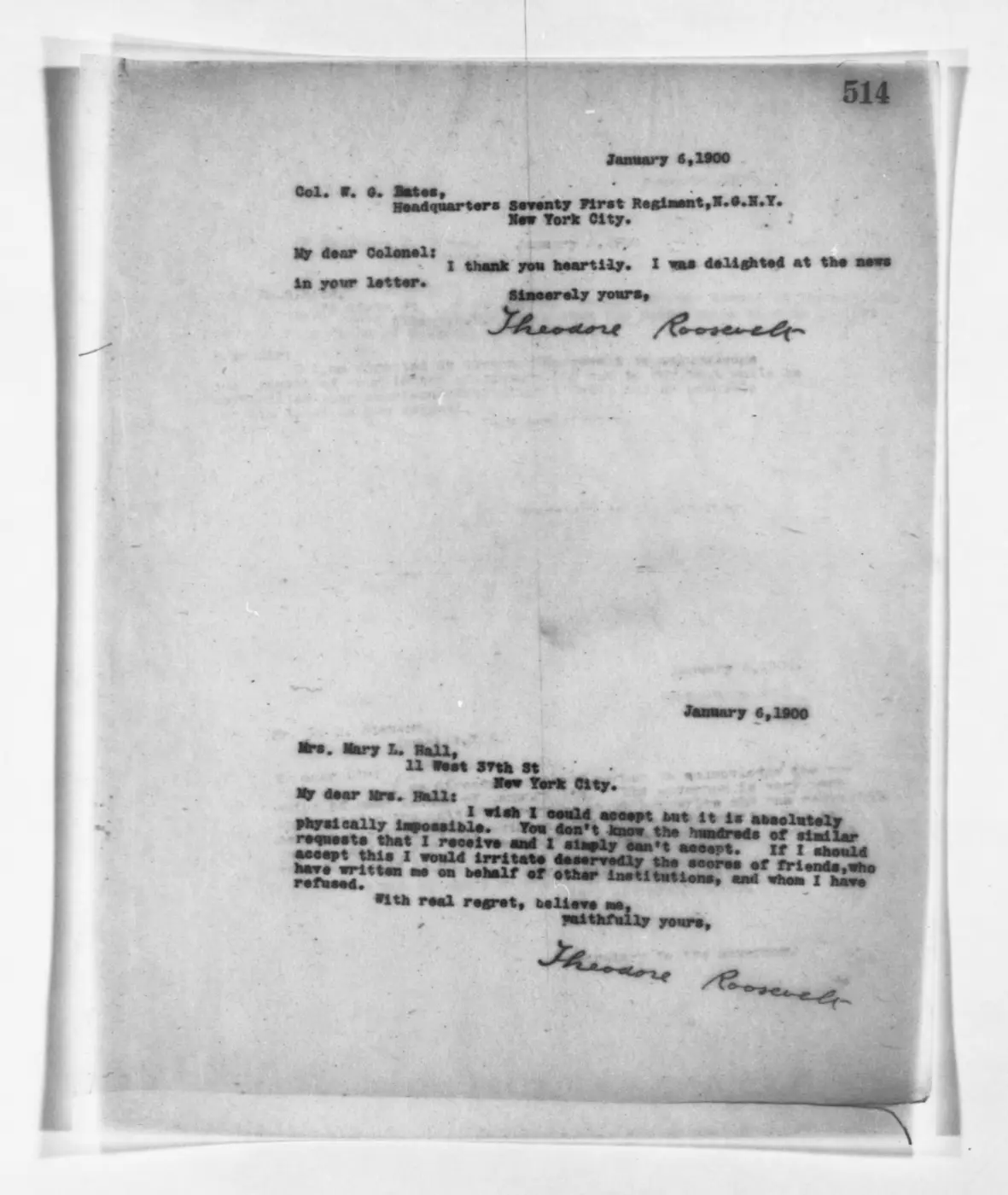
Carbon copies read like clean pages
| Tool | Carbon, 6 pages | Clean, 8 pages |
|---|---|---|
| Apple Vision | 89.3% | 91.0% |
| Our Actor | 89.7% | 88.2% |
| Tesseract, default | 90.4% | 87.6% |
All 6 carbon pages come from 4 items in the Catt papers. We labeled them carbon by eye.
Worn type still costs words. On a 1913 typescript, Apple Vision read "schuol" and "advantagos".
On a Mac: Apple Vision, free
Apple Vision comes with macOS. It made the fewest character errors on all 3 kinds of typed page.
- A scanned PDF: our free Mac script. Its default is the Vision setting tested here.
- One page image: Live Text in Preview. Not tested on these pages.
- Faded pages: check the text against the page by eye.
No Mac, or many PDFs: our Actor
Our Apify Actor, PDF to Markdown OCR, reads scans and PDFs from a link. It came second overall.
- On 3 faded pages it switched to its second reader, RapidOCR. There it found 55.9%, Tesseract 17.8%. Apple Vision still found more.
- Two misses: on a short letter it read only 3 lines of the page, 26% of the words. On one spread it read two blocks out of order, though it found 93% of the words.
- $0.006 per OCR page. Pages with their own text layer are free.
Volunteers typed the answer key
Volunteers of By the People, at the Library of Congress, typed out each page. We scored every tool against their text.
- Volunteers fix typos and join lines, so the key is a bit tidier than the page.
- Pen notes and signatures count, so on those pages no typed-text reader can reach 100%.
- 20 pages from 3 collections. Read the faded row, 605 words, as a direction, not a precise score.
- Handwriting was left out. On 3 handwritten pages, no tool found more than 18.1% in total.
Where the 20 pages come from
- Theodore Roosevelt Papers: 6 letterpress copy pages of his own letters.
- Carrie Chapman Catt Papers: 11 typed pages from its speech file.
- National American Woman Suffrage Association Records: 3 typed pages.
- The Library of Congress says the Catt and NAWSA scans, and Roosevelt's own letters, are in the public domain and free to use and reuse.
- We left out 8 other items over their rights lines.
- Pages were drawn in a seeded order. The kind of page was labeled by eye from a small image.
- Images: the Library's own, at most 3,500 px on the long side.
- A two-page spread gives each page about 175 dpi.
How we ran it
- A Mac with Apple silicon, macOS 26.6.
- Apple Vision: VNRecognizeTextRequest, accurate, language correction on, the default language.
- Tesseract 5.5.4, English: psm 3 and psm 6.
- Our Actor: its page code, build 0.1.145, the live build, run on this Mac with plain text output. Not an Apify run.
- The truth: the volunteer text, with the credit line and the transcription markup removed.
- Scripts and results stay in our private repo, in research/bench/transcribe-historical-documents-2026-11-26/.
Questions people ask
Can OCR transcribe historical documents?
Typed ones, mostly. On 20 typed Library of Congress pages, Apple Vision found 87.8% of the words. Faded letterpress copies and handwriting are much harder.
What is the best free OCR for old typed documents?
On our 20 pages, Apple Vision, which comes with macOS, found 87.8% of the words. Tesseract, a free open source reader, found 84.1%.
Does OCR work on carbon copies?
Yes, on our 6 carbon copy pages. Apple Vision, Tesseract and our Actor each found about 90% of the words.
Related guides
- Cursive to text: 5 readers tested on old handwriting
- Fraktur OCR with Tesseract: 6 models tested on old German
- Kraken OCR on a scanned PDF: Mac setup and results, tested
- How to OCR a PDF on a Mac: 4 ways, tested
- Apple Vision OCR vs Tesseract, tested on 523 scans
- How to improve Tesseract OCR accuracy (tested, 2026)